

 Cultural Couture
 Bespoke Bridal
 Ready-To-Wear
 Legacy Brides Initiative
Aug
Nineteen percent. That is the share of brides who wore custom-made attire on their wedding day, out of the 10,474 couples surveyed for The Knot’s 2026 Real Weddings Study. Four out of five chose from what already existed, in a size that came close, and then paid someone to argue with the seams.
There is nothing wrong with that. Plenty of beautiful gowns come off a rack. But if you have been saving images for eighteen months and none of them is quite the dress in your head, the reason is usually simple: the dress in your head has not been made yet.
This is a guide to having it made. What the process actually involves, what it costs in Nigeria and abroad, how far ahead you need to start, how fittings work when you live in Houston and your designer is in Lagos, and what happens to your gown at customs. At the end there is a form to book a consultation, whether you are twenty minutes from Ojota or eleven hours away.
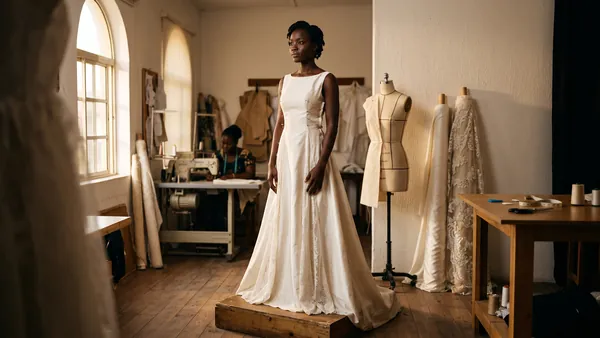
To design your dream wedding dress, you commission a garment that does not exist yet: you brief a designer, approve a sketch, choose fabric, and the gown is drafted to your measurements from scratch. Most of the industry quotes 9 to 12 months, but the bulk of that is a production queue and an international shipping leg rather than sewing. Bojamiley builds in-house in Lagos and needs four to eight weeks from design sign-off to a finished gown, with two months preferred over one because the extra weeks buy a toile and a third fitting rather than faster stitching. Expect at least two fittings, including a toile (a test garment in cheap cloth) before anyone cuts silk. At Bojamiley, custom bridal commissions run ₦800,000 to ₦5,000,000, fabric included, accessories priced separately. International brides work through video consultations, a measurement protocol, virtual fittings and a built-in alteration allowance, and should budget separately for shipping plus import duty, which is now charged on shipments to the US at any value.
- What “designing” a wedding dress actually means
- What a custom wedding dress costs in 2026
- How long it takes, and when to start
- The consultation: what happens and how to prepare
- The seven stages of a commission
- Commissioning from abroad: fit, fittings and trust
- Shipping, duty and what lands on your doorstep
- How to vet any bridal designer, Bojamiley included
- Six mistakes that cost brides money
- Book your consultation
- Frequently asked questions
1. What “designing” a wedding dress actually means
A custom wedding dress is a gown drafted from a new pattern, built to one person’s measurements, from a design agreed before any fabric is cut. That is the whole definition. Everything else people call custom is a variation on altering something that already exists.
The distinction matters because the word gets used loosely, and the price gap between the three tiers is enormous.
| Route | What you actually get | Fit | Lead time | Typical spend |
|---|---|---|---|---|
| Off the rack | A finished gown in a standard size, bought and taken home | Standard sizing, then alterations | Immediate to 8 weeks | Lowest, but alterations add up |
| Made to measure | An existing house design, cut to your measurements. Silhouette is fixed, details may be adjustable | Good, built from your numbers | 3 to 6 months | Mid |
| Fully bespoke | A new design and a new pattern. Silhouette, neckline, sleeve, train, beading and fabric all decided by you and the designer | Built to you, refined across fittings | 9 to 12 months through a boutique. 4 to 8 weeks with an in-house atelier | Highest |
There is a fourth category that pretends to be the third. Search “custom wedding dress” and a wall of listings appears at $130 to $360, shipped from a single industrial city, offering “custom made” in fourteen sizes plus a free-text box for your instructions. Those are factory gowns produced to a size chart. Somebody may well take a tape measure to a pattern block. Nobody is drafting for your shoulders.
The tell is the toile. A real bespoke commission includes a test garment, usually in calico or cheap cotton, sewn and fitted on you before the good fabric is touched. If a designer’s process has no toile stage and no fitting before construction, you are buying made-to-measure at best. Ask about it in the first conversation. The answer tells you almost everything.
Where the Nigerian bride sits in all of this
Differently, and it is worth naming. A Nigerian wedding is rarely one dress. There is the traditional ceremony, the white wedding, the reception change, sometimes a court sitting weeks earlier, and increasingly a separate look for the after-party. We have written a full breakdown of how many outfits a Nigerian bride actually needs, because the answer surprises people and it drives the whole budget.
This changes the economics of designing. A bride commissioning one gown is making a single decision. A bride commissioning a white gown, a cultural couture look for the traditional, and a reception dress is running a small production schedule, and the sequencing matters as much as the designs.
2. What a custom wedding dress costs in 2026
The honest answer has two halves, because Nigerian and international brides are looking at different reference points.
In the United States, the average spend on a wedding gown is roughly $2,100, per The Knot’s 2026 study of couples married in 2025. That average is dominated by off-the-rack and made-to-order purchases, since only about a fifth of respondents wore anything custom. Custom sits above it, usually well above it.
In Nigeria, the reference point is the wedding itself. Industry analysts put the country’s wedding economy at roughly ₦1.2 trillion a year once fabric, tailoring, catering and logistics are counted. A mid-scale Lagos wedding runs between ₦15 million and ₦25 million, according to the Event Industry Conference Report, and data from Cowrywise cited in 2026 puts the average Nigerian couple’s full wedding spend near ₦13 million. Against those numbers, a gown is a line item, not the budget.
| Tier | What it buys | Naira | Approximate USD |
|---|---|---|---|
| Factory “custom” | A size-chart gown from an overseas listing. No fitting, no recourse, quality unverifiable before delivery | Under ₦500,000 | Under $360 |
| Bojamiley commission, entry | Bespoke draft, clean construction, considered fabric, full fitting process | From ₦800,000 | From about $570 |
| Bojamiley commission, mid | More complex construction, structured corsetry, imported lace, hand detailing | ₦1,500,000 to ₦3,000,000 | About $1,070 to $2,150 |
| Bojamiley commission, upper | Heavy hand beading, extended trains, multi-layer construction, extensive handwork hours | Up to ₦5,000,000 | Up to about $3,600 |
Two things that band does not include. Accessories are priced separately, because a veil, a headpiece and a bolero are their own construction jobs and pretending otherwise inflates the headline number dishonestly. International shipping is also separate, and so is whatever your country’s customs authority decides to charge, which is covered in section seven.
The diaspora arbitrage is real, and it is not the whole story. A gown that would cost $6,000 to commission in London or New York can be commissioned in Lagos for a fraction of that, because the labour cost of skilled handwork is different, not because the handwork is worth less. But subtract the saving you lose to shipping and duty before you fall in love with the maths. The genuine advantage is usually access to a level of construction and cultural fluency you cannot buy in a Western bridal salon at any price, not the discount.
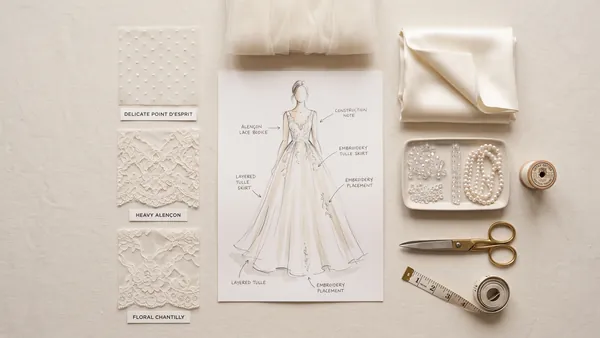
What actually moves the price
Not the silhouette. A mermaid and an A-line take comparable time to draft. The cost lives in four places.
Hand hours. Beading is charged in labour, not in beads. A bodice covered in hand-applied crystal can carry more working hours than the rest of the gown combined.
Fabric. Imported French lace, silk mikado and heavy duchesse satin sit in a different bracket from good local alternatives, and a train multiplies the metreage.
Structure. An internal corset, boning, a built-in bra and a horsehair hem are engineering. They are also the reason a gown holds its line through eight hours and a thousand photographs.
Revisions after sign-off. Changing the neckline after the pattern is cut means a new pattern. Designers who never mention this are the ones who charge for it later.
3. How long it takes, and when to start
Search this question and you will be told 9 to 12 months more or less everywhere, with 4 to 6 given as a compressed minimum. That number is real, it is published by serious ateliers, and it is worth understanding before you accept it, because most of it is not sewing time.
Here is what those months are actually spent on in the conventional model. A boutique does not build your gown. It takes your order, places it with a designer whose production sits in a factory in another country, and joins a queue behind every other boutique. The gown is then made, shipped internationally, received, and only then fitted and altered by a third party. Made-to-order gowns from established labels routinely take 4 to 8 months in production before an alterations appointment even begins. The wait is a supply chain, not a craft.
Four to eight weeks from design sign-off to a finished gown, and we would rather have eight than four. The atelier is in-house on Victoria Street, Ojota. There is no queue, no overseas factory, no shipping leg between the pattern and the fitting room. The people who draft your pattern, cut it, build it and fit it are in the same building, which removes almost everything the conventional timeline is actually waiting for.
So the honest answer to a bride whose wedding is in ten weeks is not “you have left it too late”. It is: bring the date, and we will tell you what it allows.
Why we still ask for two months rather than one
One month is genuinely deliverable and it has been delivered. Two is better, and the reason is not caution, it is refinement.
The extra weeks do not go into sewing faster or slower. They go into the toile, into a second and third fitting, into the days between fittings where a bodice sits on a form and somebody looks at it again with fresh eyes and moves a seam four millimetres. That is the margin between a gown that fits and a gown that fits like it grew on you. Hand beading is the one element that cannot be compressed past a point, because it is charged in hours and the hours are the work.
Time also buys you the right to change your mind. A bride with ten weeks can revise a neckline after seeing the toile. A bride with four is committing at sketch stage and living with it.
What each stage actually takes
| Stage | Typical duration | What determines it |
|---|---|---|
| Consultation to sketch and quote | 3 to 7 days | How quickly you can meet, and how clear the brief is |
| Sketch approval and deposit | Entirely yours | This is the stage brides lose the most time in |
| Fabric sourcing and pattern drafting | 1 to 2 weeks | Longer if a specific imported lace has to be brought in |
| Toile and first fitting | Within week 2 to 3 | Dropped only on a genuinely compressed build |
| Construction | 2 to 4 weeks | Beading hours, corsetry, train length, layering |
| Second and final fittings | Final week | Hem is set here, with your actual shoes |
| Finishing, pressing and packing | 2 to 3 days | Add shipping time for international delivery |
Counted end to end, that is four to eight weeks of atelier time. Everything beyond it is comfort, and comfort is worth having if you can afford it. If you are twelve months out, book anyway and spend the surplus on getting the design exactly right rather than on waiting in somebody’s production queue.
The one thing that genuinely runs on a long clock. Not construction. Capacity. The atelier takes a limited number of commissions in any given month, and the December to January corridor is the busiest stretch of the Nigerian wedding calendar. The gown takes four to eight weeks. Securing a slot in a peak month is a separate question, and it is answered on a first come basis. That is the real reason to enquire early, and it is a different reason from the one the rest of the industry gives you.
Two dates that matter more than the rest
The clock starts at deposit and design sign-off, not at your first message. The gap between quote and approval is entirely within your control and it is where most of the pressure in a compressed timeline is actually created. A bride who takes three weeks to approve a sketch has not bought three extra weeks. She has spent them, and out of the construction budget rather than the calendar.
The second date is the hem. The final hem is set with the shoes you will actually wear, at the height you will actually wear them. Buy the shoes before the last fitting. This one sentence saves more gowns than any other advice in this guide.
For an international commission there is a third: add shipping and a local alteration window on top of the build. A gown finished in Lagos on the Monday is not a gown hanging in a wardrobe in Maryland on the Tuesday. Section seven covers what happens in between.
4. The consultation: what happens and how to prepare
A first consultation is not a sales meeting and it is not a fitting. It is a briefing, and its purpose is to find out whether the picture in your head and the gown a designer would build for you are the same object.
Expect it to run 45 to 90 minutes. Expect to be asked about the venue, the ceremony type, the time of day, the weather, how long you will be standing, whether you are dancing, and who is going to be looking at you and with what expectations. All of that is construction information. An outdoor Lagos ceremony in February and an evening reception in a Toronto hotel are different engineering problems, and a designer who does not ask is not designing, only decorating.
What to bring
- Twelve to twenty reference images, not two hundred. A large board tells a designer nothing. A tight one tells them exactly what you keep returning to.
- Images of what you do not want. Rarer, more useful. The negative brief closes off entire directions in one minute.
- Your date, your venue and your ceremony sequence. Including any other looks you are commissioning, so the whole wardrobe can be sequenced.
- A real budget figure. Not a coy one. A designer who knows the ceiling can design to it. A designer guessing will design something you have to reject, and you will both have lost a week.
- A photograph of yourself you like. It says more about how you want to be seen than any gown reference does.
What you should be asking
Whether the toile is included. How many fittings the price covers. What a design change costs after sign-off. What the deposit is, what it secures, and what happens to it if you cancel. Who owns the sketch. What the delivery date actually is, in writing. Whether alterations after delivery are included, and for how long.
You are allowed to ask all of this in a first meeting. Any designer who treats those questions as impolite has told you something useful.
5. The seven stages of a commission
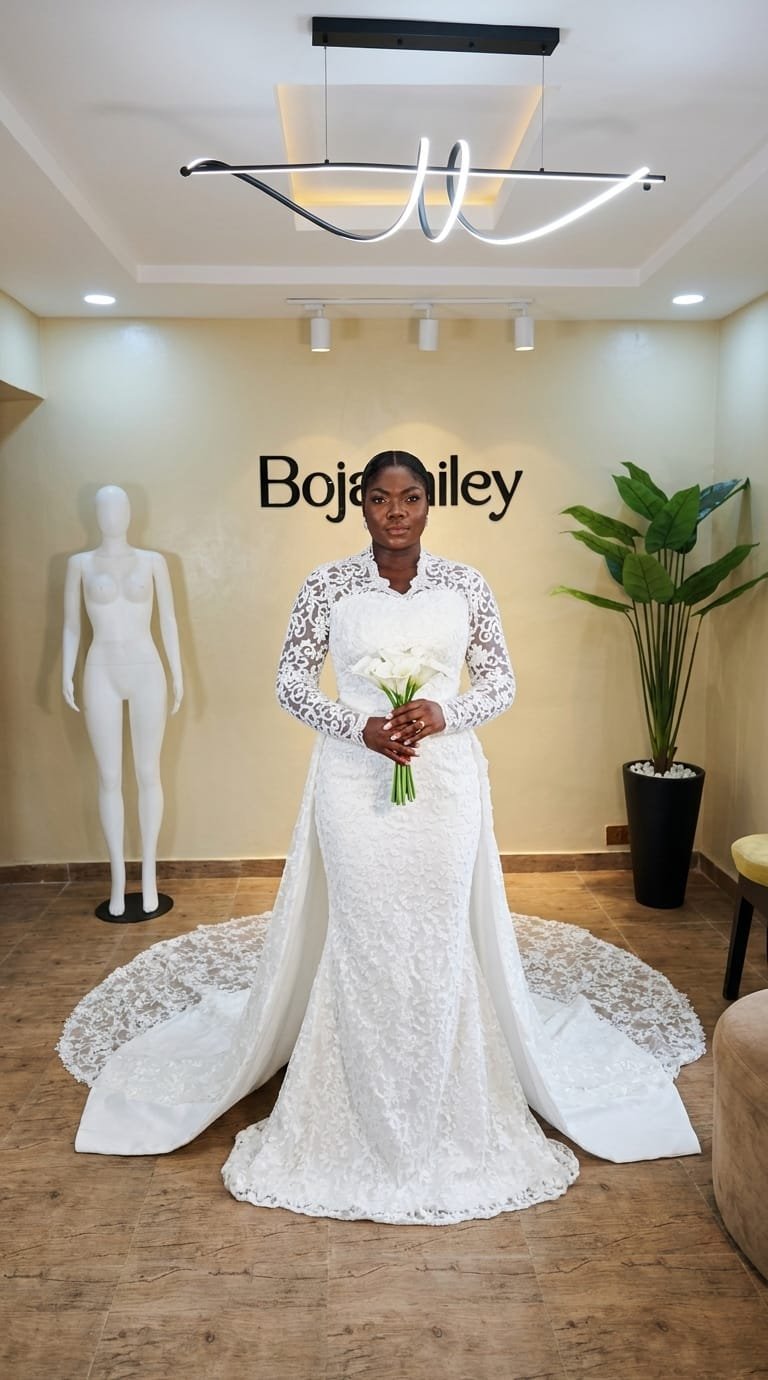
Different houses name these differently. The sequence is broadly universal, and knowing it lets you tell where you are and whether anything has quietly stalled. At Bojamiley the whole sequence runs inside four to eight weeks, which is only possible because stages four through six happen under one roof.
Stage one: the brief
The consultation, in studio or on video. You talk, the designer listens and asks the awkward questions. Nothing is committed.
Stage two: sketch and quote
You receive a rendered design and a price against it. This is the point of negotiation, on both design and cost. Read the quote for what it excludes as carefully as what it includes.
Stage three: sign-off and deposit
You approve the design in writing and pay a deposit. The production clock starts here. Ask for the delivery date to be stated on the same document.
Stage four: fabric and pattern
Fabric is sourced and reserved, and a pattern is drafted to your measurements. This is skilled, invisible work, and it is where most of the gown’s eventual fit is decided.
Stage five: the toile
A test garment in inexpensive cloth is made and fitted on you. It will look unglamorous. It is the most important appointment in the process, because it is the last cheap place to change your mind about proportion, neckline height, and where the waist actually sits on your body rather than on a diagram.
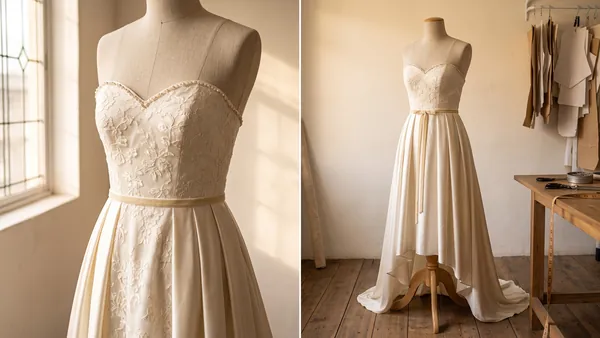
Stage six: construction and fittings
The real fabric is cut. Two to three fittings follow, each one tightening the fit and correcting what only shows up in movement. The hem is set last, with your shoes.
Stage seven: finish and delivery
Hand finishing, pressing, and packing. For international commissions this is also when the shipping paperwork is prepared, and getting the declaration right matters more than most people expect. Section seven covers why.
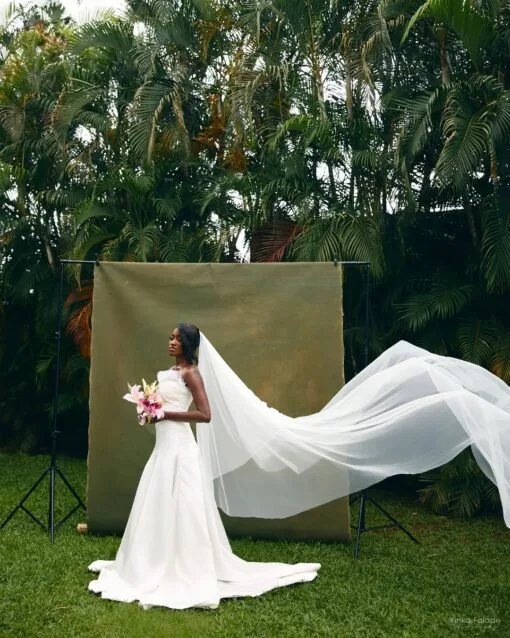
6. Commissioning from abroad: fit, fittings and trust
This is the section diaspora brides actually came for, so here it is without the reassurance padding.
The fear is not really about design. It is about three things: that the money will vanish, that the gown will not fit, and that if either goes wrong you will be five thousand miles away with no leverage. All three are legitimate. All three are manageable, and the way they are managed should be visible to you before you pay anything.
The fit problem, and what actually solves it
A gown cannot be built accurately from measurements you took yourself with a soft tape and a bathroom mirror. That is the honest constraint. What solves it is not trust, it is protocol.
- Professional measurement. Book a local tailor or alterations shop for a full measurement session, roughly thirty minutes and modestly priced almost anywhere. Bojamiley supplies the measurement sheet specifying exactly which points are needed and how each is taken. Take them in the underwear you will wear on the day.
- Photographic reference. Front, side and back in fitted clothing, against a plain wall, full length, with a known reference object in frame. These correct for posture in a way numbers never do.
- Virtual fittings. Scheduled video sessions during construction, with the garment on your body and a second person holding the camera. You will be given specific instructions on what to show and from what angle.
- A built-in alteration allowance. The gown is constructed with extra fabric in the seams so a local tailor can take it in on arrival. This is the safety net that makes remote commissioning workable at all. Ask for it explicitly and ask how much allowance has been left.
- Arrival buffer. The gown should land with you a minimum of three to four weeks before the wedding, not three days. That buffer is not caution, it is the alteration window.
Budget for one local alteration. Not because something has gone wrong, but because it is the correct plan. Bodies change across a long engagement, and the last centimetre of a bodice is best set by someone standing in the room. Plan for it, price it in, and it stops being a crisis and becomes a fitting.
The money problem
Structure the payment so no single moment carries all the risk. A deposit at sign-off, a staged payment at the toile, and the balance before shipping is a normal and defensible structure. A designer who wants everything up front, or who will only accept payment to a personal account with no documentation, is telling you how the relationship will run if something goes wrong. We wrote a longer piece on vetting Nigerian designers from abroad, and section eight below covers the checks in brief.
7. Shipping, duty and what lands on your doorstep
Most bridal content ignores this entirely, which is how brides end up with a courier invoice they did not budget for while the gown sits in a warehouse. The rules changed materially in the last eighteen months and a lot of published advice has not caught up.
The United States no longer has a duty-free threshold. The $800 de minimis exemption was suspended for all countries from 29 August 2025, and on 24 June 2026 US Customs and Border Protection moved that suspension from executive order into regulation, indefinitely, across every shipping mode including international post. Every inbound shipment now requires a customs entry with a tariff classification, and duty is assessed regardless of value. Under the One Big Beautiful Bill Act the exemption is also scheduled to be eliminated by statute from 1 July 2027.
Practically: a gown shipped to a US address will attract duty at the applicable apparel rate plus current surcharges, and the courier will bill it, usually on delivery, along with a brokerage fee.
| Destination | Duty position, August 2026 | Sales tax or VAT | What to expect on delivery |
|---|---|---|---|
| United States | No de minimis. Duty applies at any value, formal or informal entry required | State sales tax not charged at import | Courier invoice for duty plus a brokerage or disbursement fee |
| United Kingdom | Customs duty above £135 customs value, which a bridal gown will exceed | Import VAT at 20 percent on almost all imports, charged on value plus duty | Duty, VAT, and a carrier clearance fee typically £8 to £25 |
| Canada | De minimis is CAD 20 for duty, so duty applies to essentially any gown | GST at 5 percent, or HST at 13 to 15 percent in harmonised provinces | Duty plus GST or HST plus a courier handling fee |
| European Union | Duty above €150 customs value | VAT on all imports regardless of value, at the national rate | Duty, VAT, and a clearance fee |
| Nigeria | Not applicable, domestic delivery | Not applicable | Courier or studio collection |
Four things that reduce the pain
Declare accurately. Under-declaring a wedding gown to reduce duty is customs fraud, and the practical downside is worse than the duty: an under-declared parcel cannot be insured for its real value. If it is lost, you are refunded the declared amount.
Ship with a courier that pre-bills. Paying duty in advance is far less painful than a courier holding your gown four days before the wedding while you find a card.
Ask whether Delivered Duty Paid is available. DDP terms mean charges are settled at the origin and quoted to you up front. Not every route offers it, but it is worth asking.
Insure at full value and keep the paperwork. The commercial invoice, the tracking record and the insurance certificate are what turn a lost parcel from a catastrophe into a claim.
8. How to vet any bridal designer, Bojamiley included
Here is a number worth sitting with. Over 80 percent of Nigerian wedding-related businesses operate outside formal business registration, per the SMEDAN and NBS MSME survey. That is not a scandal, it is the structure of an informal economy that also produces genuinely world-class craftsmanship. But it does mean the burden of verification sits with you, and it means the usual signals are weak. A beautiful Instagram grid costs nothing to assemble and is not evidence of anything.
Apply these to us as readily as to anyone else.
Six checks that actually discriminate
Ask for a photograph of a client wearing the gown, not the gown on a stand. Studio images are styled and lit and pinned at the back. A real bride, on a real day, in real light, moving, is a different quality of evidence. Any established house has hundreds.
Ask to see the inside of a finished gown. Seam finishing, boning channels, linings and the way a zip is set are where construction quality lives. Nobody photographs the inside for marketing. A house that will send you that photograph on request is confident about it.
Ask what happens if the gown does not fit on arrival. Listen for a specific process, an alteration allowance, a timeline. A vague reassurance is a no.
Ask for a written specification before you pay. Design, fabric, delivery date, payment schedule, what a change costs. It does not need to be a legal document. It needs to exist.
Look for a physical address you could actually visit. Bojamiley is at No 13 Victoria Street, Ojota, Lagos. That is checkable, and a designer whose only address is a WhatsApp number has removed your only real leverage.
Look for the awkward information. Published prices, stated timelines, a named founder, an honest account of what the house does not do. Vagueness is a business decision, and it is usually made for a reason.
The one red flag that overrides the others. Any designer who will not put a delivery date in writing before taking your deposit. Not “around November”. A date. Everything else on this list can be worked around. That one cannot.
9. Six mistakes that cost brides money
Assuming a short runway rules you out, and giving up on a commission entirely. Plenty of brides buy off the rack in a panic at ten weeks because every website told them custom takes a year. An in-house atelier does not work on that clock. Ask before you settle. The constraint that actually bites is a peak-month capacity slot, not the build.
Approving a sketch slowly. Every week between quote and sign-off comes out of the construction schedule, not out of the delivery date.
Changing the design after the pattern is cut. A neckline change at sketch stage is a conversation. The same change after cutting is a new pattern and, sometimes, new fabric.
Buying the shoes last. The hem is set to the shoe. Change the heel height by two centimetres after the final fitting and the gown is wrong at the floor, which is where everyone looks in the photographs.
Planning a body that does not yet exist. Commission for the body you have. A gown can be taken in comfortably. Letting one out is limited by the seam allowance that exists, and by the fabric that was bought.
Budgeting the gown and forgetting the rest. Veil, headpiece, undergarments, alterations on arrival, shipping, duty. On an international commission these can add a meaningful percentage to the number you thought you were spending. Ask for the total landed figure at the quote stage, not the garment figure.
10. Book your consultation
The consultation is free, it commits you to nothing, and you can take it from anywhere. In studio at Ojota if you are in Lagos, or on video if you are in Houston, London, Calgary, Dublin or Dubai. Sessions are scheduled in West Africa Time and we will work around your time zone, including early mornings and late evenings.
Tell us the date, the ceremony and roughly what you have in mind. We will come back within two working days with a time.
Design Your Dream Wedding Dress
A free consultation with the Bojamiley atelier. In studio in Lagos, or on video anywhere in the world.
Prefer to talk first? We answer both of these.
WhatsApp us +234 813 365 1906 bojamiley@gmail.com
Bojamiley atelier, No 13 Victoria Street, Ojota, Lagos, Nigeria. Consultations by appointment.
Frequently asked questions
How much does it cost to design a custom wedding dress in Nigeria?
At Bojamiley, bespoke bridal commissions run from ₦800,000 to ₦5,000,000, with fabric included and accessories priced separately. Where a gown sits in that band depends mainly on hand hours rather than silhouette: heavy hand beading, structured internal corsetry, imported lace and long trains all move the figure upward. For comparison, the average American bride spent about $2,100 on her gown according to The Knot’s 2026 Real Weddings Study, and that figure is dominated by off-the-rack and made-to-order purchases rather than bespoke work. International clients can be quoted in USD, GBP or CAD at the prevailing rate.
How long does it take to design a wedding dress from scratch?
Most bridal websites quote 9 to 12 months, but that figure describes the conventional model, where a boutique orders your gown from a designer’s overseas production queue and waits for it to be manufactured and shipped before alterations even start. Bojamiley builds in-house in Lagos, so there is no queue and no shipping leg in the middle of the process. A bespoke gown takes four to eight weeks from design sign-off to completion. We ask for two months rather than one where possible, because the extra weeks buy a toile fitting and a third fitting rather than faster sewing. Add shipping time and a local alteration window for international commissions.
Can I design my dream wedding dress if I live abroad?
Yes, and it is a well-established route. The consultation happens on video, the design is agreed remotely, and the gown is built to measurements taken by a professional tailor in your own city following a measurement sheet supplied by the atelier. Virtual fittings are scheduled during construction, and the gown is constructed with a deliberate alteration allowance in the seams so a local tailor can make the final adjustment on arrival. Bojamiley works this way with brides across the United States, the United Kingdom, Canada, Ireland and the Gulf.
How do wedding dress fittings work if I cannot travel to Lagos?
Through a combination of professional measurement, photographic reference and scheduled video fittings. You book a local tailor for a full measurement session and take the measurements in the underwear you will wear on the day. You supply front, side and back full-length photographs against a plain wall, which correct for posture in a way numbers alone cannot. During construction you join video sessions with the garment on your body and someone else holding the camera. The gown then ships with an alteration allowance so a local tailor can complete the final fit.
What is a toile and do I really need one?
A toile is a test version of your gown sewn in inexpensive cloth, usually calico, and fitted on you before any of the real fabric is cut. It looks unglamorous and it is the single most valuable appointment in the process, because it is the last inexpensive place to change your mind about proportion, neckline height and where the waist actually sits on your body. If a designer’s process contains no toile stage, you are buying made-to-measure rather than true bespoke. Ask about it during the first conversation.
What happens if my wedding dress does not fit when it arrives?
This is why the gown is built with an alteration allowance and why it should arrive three to four weeks before the wedding rather than three days. That buffer is the alteration window. A local tailor can take a bodice in comfortably, which is the common adjustment after a long engagement. Budget for one local alteration as part of the plan rather than treating it as a failure. Before committing to any designer, ask them directly what their process is if the gown does not fit on arrival, and listen for a specific answer with a timeline attached rather than a general reassurance.
Do I have to pay customs duty on a wedding dress shipped from Nigeria?
In most destinations, yes. The United States suspended its $800 duty-free de minimis exemption for all countries from 29 August 2025, and US Customs and Border Protection made that suspension indefinite by regulation on 24 June 2026, covering every shipping mode including international post. The United Kingdom charges customs duty above a £135 customs value plus import VAT at 20 percent, and a bridal gown will exceed that threshold. Canada’s duty threshold is only CAD 20. Budget for duty, any local tax, and a courier brokerage fee, and never under-declare, because an under-declared parcel cannot be insured for its real value.
Can I commission a traditional outfit and a white gown at the same time?
Yes, and commissioning them together is usually the better decision. A Nigerian wedding is rarely a single look: there is the traditional ceremony, the white wedding, often a reception change and sometimes a separate court sitting weeks earlier. Handling the wardrobe as one commission lets the sequence be planned around a single production schedule and keeps the looks in conversation with each other rather than competing. Bojamiley builds across bespoke bridal, cultural couture including Aso Oke and Aso Ebi, court and reception dresses, so the whole sequence can be handled in one atelier.
What deposit is required, and what does it secure?
A deposit is paid at design sign-off and it secures two things: your place in the production calendar and the fabric reservation. The production clock starts from that point. A sensible structure for any commission, with any designer, is staged: a deposit at sign-off, a payment at the toile fitting, and the balance before shipping, so no single moment carries all the risk. Ask what the deposit covers, what happens to it if you cancel, and insist the delivery date appears in writing on the same document. Any designer unwilling to put a date in writing before taking money is the one red flag worth walking away from.
Can a custom wedding dress be made in one month?
Yes. Bojamiley builds bespoke gowns in four to eight weeks, and one month is deliverable because the atelier is in-house in Lagos rather than ordering from an overseas production queue. We ask for two months where the calendar allows, not because a month is not enough to sew a gown, but because the second month buys a toile fitting, a third fitting and the days in between where a seam gets looked at again and moved. Heavy hand beading is the one element that cannot be compressed much, since it is charged in hours. If your date is close, bring it to the consultation and you will get a straight answer about what it allows rather than a refusal.
What should I bring to a wedding dress consultation?
Twelve to twenty reference images rather than two hundred, because a tight selection tells a designer what you keep returning to. Bring images of what you do not want as well, since the negative brief closes off whole directions in a minute. Bring your date, your venue, the full ceremony sequence and any other looks you are commissioning. Bring a real budget figure rather than a coy one, so the design can be built to it. Finally, bring a photograph of yourself that you like, which says more about how you want to be seen than any gown reference can.
Is a custom wedding dress cheaper than buying one from a boutique?
Sometimes, but that is the wrong reason to commission one. Commissioning from Lagos can cost meaningfully less than an equivalent commission in London or New York, because the cost of skilled handwork differs by market. Subtract shipping and import duty before treating the gap as a saving. The real argument for designing your own gown is not price: it is that you get a garment drafted to your body, in a design that exists nowhere else, with cultural elements a Western bridal salon has no vocabulary for. If price is the only consideration, an off-the-rack gown with good alterations is the more rational purchase.
The dress in your head has not been made yet.
Free consultation, in studio in Lagos or on video anywhere in the world. No commitment, and an honest answer about what your date allows.
Book your consultationIf you would rather browse before you talk, start with the Bespoke Bridal collection, or look at finished work in bespoke bridal wear, reception dresses and court dresses. If your wedding involves a registry sitting first, our guide to court wedding dresses and what to wear to your registry covers that ceremony in full.
Bojamiley is a Lagos couture house founded by designer and CEO Adebayo Oluwatimileyin, headquartered at No 13 Victoria Street, Ojota, Lagos, working across bespoke bridal, cultural couture, occasion and evening wear, prom commissions and ready-to-wear. Pricing bands, production timelines, wedding industry figures and the customs, duty and de minimis rules described here were accurate as of August 2026. Import rules in particular are changing quickly: the US de minimis suspension was made indefinite by regulation on 24 June 2026 and is scheduled for statutory elimination on 1 July 2027, and the UK has signalled changes to its own £135 threshold. Confirm current duty rates and thresholds with the relevant customs authority at the time you order. Exchange rate conversions are indicative only and were calculated at approximately ₦1,400 to the US dollar.

Pingback: Wedding Reception Dresses: The Bride's Second-Look Guide